Showing posts with label American History 101. Show all posts

Sunday, October 6, 2024

American History 101: The History of John's Taylors Pork Roll

When it comes to iconic American foods, few can rival the quirky charm and delicious mystery of Taylor’s Pork Roll. This beloved New Jersey staple has been tantalizing taste buds since the 19th century, but how much do you really know about its storied past? From its humble beginnings in Trenton to its status as a breakfast legend, Taylor’s Pork Roll is more than just a meat product—it’s a slice of culinary history. Join us as we dive into the savory saga of this unique delicacy, exploring its origins, its rise to fame, and why it continues to hold a special place in the hearts (and stomachs) of so many. Are you ready to learn the history behind John Taylor's invention and -- finally -- put the debate about what its name is and how it got that name?

Get ready for a mouthwatering journey through time!

The Birth of Taylor's Prepared Ham: A Culinary Legend

Picture this: It's 1856 in Trenton, New Jersey, and a savvy state Senator named John Taylor is about to change breakfast forever. Known around Hamilton Square as a shrewd businessman, Taylor concocted a delectable blend of spices, salt, sugar cure, and preservatives, then smoked it to perfection. The result? A mouthwatering meat marvel he proudly dubbed "Taylor’s Prepared Ham."
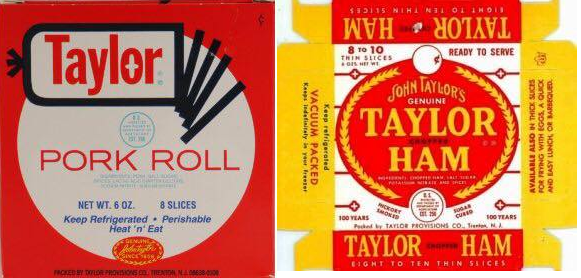

But wait, the plot thickens! Fast forward to the early 1900s, and the Pure Food and Drug Act swoops in, declaring that Taylor's creation doesn't quite meet the strict definition of "ham." Undeterred, Taylor rebrands his beloved product as the "Original Taylor Pork Roll," and a legend is born. Despite the bureaucratic hiccup, this tube-shaped treat has secured its place in the annals of American culinary history, beloved by breakfast enthusiasts far and wide.

Rebranding a Future Legend

When John Taylor and his company, Taylor Provisions (established in 1939), decided to rebrand their beloved creation as "pork roll," they hoped to corner the market and keep competitors at bay. The plan? Trademark the new name and make Taylor's product the one and only pork roll in town.

But, as with many great plans, things didn't go quite as expected. The trademark attempt fell flat, and soon enough, other companies started rolling out their own versions of the tasty treat. Today, names like Case Pork Company, Mercer Meats, Thumann’s, and Kohler Provisions are all part of the pork roll family. Yet, ask any true New Jerseyan, and they'll tell you Taylor Provisions is the original.

Interestingly, George Washington Case of Case Pork Company began selling his hickory-smoked pork rolls from his Belle Mead farm in Somerset County back in 1870, just over a decade after Taylor's first batch hit the market.

Now, both Taylor Provisions and Case Pork Company call Trenton home, making New Jersey's capital the unofficial epicenter of the great pork roll vs. Taylor ham debate. 

Absolutely, here’s a more entertaining version of the phenomenon story:

Becoming a Phenomenon: The Pork Roll Craze

What started as a humble cured meat has now exploded into a statewide sensation, gracing the shelves of nearly every deli in New Jersey. It’s even made its way into Pennsylvania and Maryland, spreading the deliciousness far and wide.

But here’s the million-dollar question: Is it Taylor ham or pork roll? According to Taylor Provisions, the names are interchangeable. In North Jersey, it’s proudly called Taylor ham, while South Jersey and Philadelphia stick to pork roll.

The debate over what to call this salty breakfast delight is still sizzling, and in New Jersey, saying “both are correct” just won’t cut it. But fear not, for Peter Genovese offers a nugget of wisdom in Thrillist: All Taylor ham is pork roll, but not all pork roll is Taylor ham. In other words, thanks to competing brands, you can have pork roll that’s not Taylor ham, but Taylor ham will always be pork roll.


So What is it?

People will call it what they call it... but today, the proper name is Pork Roll - much like you make copies, not Xeroxes.  If Taylor had his way, it would have been called Taylor's Prepared Ham - but since it was not actually ham, he did not get his way.

One thins is for sure: New Jersey is undeniably the Taylor ham/pork roll capital of the United States, and probably the world. Trenton, USA - Pork Roll Capital of the World!

~~~
Bruce holds degrees in Computer Science, Biblical History, and American History from Temple University and Liberty University; he has also completed a Doctorate in Educational Organizational Leadership at Abilene Christian University.  He is a member of the Epsilon Pi Tau Honor Society, Golden Key Honor Society, Historical Studies Honor Society, and the Saber and Scroll Society.  He has worked in educational technology for 30 years and specializes in building infrastructures for schools that work to support the mission of technology in education in the classroom.  He has also served as a classroom teacher in computer science, history, and English classes at both the high school and College levels.  His baseball career spanned almost 15 years, from high school through Division I college ball and experience in MLB.  He has coached players at various levels from ages 8 through 18.

Friday, December 23, 2016

American History 101: How NORAD Started Tracking Santa Claus!

This year a record number of children (and adults, let's be honest here people...) will spend a reasonable amount of time tracking Santa Clause via NORAD's App, or the website or even following the Big Guy's progress on Twitter.  Over the past several decades, we have all grown accustomed to hearing updates from NORAD on Santa's progress, and NORAD has kept up with the technology by adding Twitter, a web page, apps for all major platforms to their phone line and radio updates.  

So how did this Christmas tradition begin?  Well... with a typo in a holiday advertisement.  That's how!

Every American has heard tales of the "red phone" that connects the hotline between the President and the commander at NORAD for that... unthinkable moment.  It is a little piece of irony that the bringer of peace, love and
Sears 1955 Advertisement to call Santa Claus
-- that actually called NORAD!
lifelong memories would come together with the bringer of destruction and obliteration... but on Christmas Eve in 1955 that is exactly what happened.  In 1950's Cold War America, that red phone did not actually go between the President and the Big Guy and NORAD, it was a red phone -- that much is factual -- but it had a phone number, just like every other phone in America.  And the only people with that number in 1955 was a four star General at the Pentagon and Colonel Harry Schoup at NORAD's Continental Air Defense Command.  And on December 24, 1955 -- Colonel Schoup hear the sound that he always feared would cut through the air... the phone rang.


Colonel Schoup must have felt a sense of apprehension and fear as he lamented that the phone just had to ring the night before Christmas, and what that might mean to the world and its children.  And as he steeled himself for the voice that would be on the other end of the phone, the voice that would mean there would be Christmas this year... instead of having to carry out orders that he never wanted to receive, he was stunned by the words that the voice on the other end of the line spoke.

"Santa, is that you?"


When Colonel Schoup heard the child on the other end of the line, his first reaction was probably not what the child was hoping for... when he said, "Is this a joke?" -- the child began to cry and he realized it was no joke at all.  Colonel Schoup decided to play along with the child, and when he'd finished hearing what the tyke wanted for Christmas, Schoup asked to speak to the child's parents.  It was only then that the child's mother told him of the advertisement that Sears ran in their local newspaper.  The advertisement told the children of America that they could talk to Santa by calling... NORAD.  Schoup quickly realized this was simply a mistake, so when he hung up the phone he was about to take steps to correct the problem -- but then the phone rang again.  And again... and again.  And after a few calls he realized that he needed help!  He acted quickly and decisively in the midst of this holiday crisis, as his military training had taught him to do.  He gathered some of the other officers, got them phones and they all began answering phone calls from children all over the country.  And when he walked into the large room with the map of the world that showed the global positioning of the American armed forces, he saw a picture of Santa Claus traveling across the country... at that moment he decided to pick up the phone and call a local radio station identifying himself as the "commander at the Combat Alert Center" and telling them that they just spotted an "unidentifed flying object.  Why, it looks like a sleigh!"  The radio station continued to check in with Colonel Schoup and get updates on Santa's location throughout the night.  And thus, the holiday tradition was born.

Throughout the years, Colonel Schoup became known as the "Santa Colonel" and was very proud of the tradition that he helped create.  He was known to carry a locked briefcase with him at all times, he was pretty important after all.  But... inside did not contain top secret papers that held information about a secret bombing (well, maybe it did...) instead, it held letters that people all over the world had written to him thanking him for all he'd done to help generate the holiday spirit for them, and their children.

Follow Santa on NORAD's App (iOS / Android / Windows), NORAD's Website or Twitter this year!

Merry Christmas to all, and to all a good night!

~~~
Bruce holds a degrees in Computer Science, Biblical History and American History from Temple University, Liberty University and American Public University.  He is a member of the Historical Studies Honor Society and the Saber and Scroll Society.  He has worked in educational technology for over 20 years, specializes in building infrastructures for schools that work to support the mission of technology in education in the classroom.  He also has served as a classroom teacher in Computer Science, History and English classes.  


Be on the lookout for Towering Pines Volume Two: The Sound and the Fury which is currently a work in progress.

Thursday, November 17, 2016

Holiday History 101: The History of Thanksgiving


Thanksgiving.... what is Thanksgiving and what does it mean to us today?  In America, we think of family, turkey and football.  We tend to gather together with family to officially kick off the six week period that we refer to as "The Holiday Season" when we are inundated with food, cooler weather and Santa Claus.  But it has not always been this way.  Where did this holiday start?  And are its roots really with the Pilgrims and Native Americans sharing the things they have in the name of peace and cooperation?

Thanksgiving Day is a national holiday celebrated in Canada and the United States. It was originally celebrated as a day of giving thanks for the blessing of the harvest and of the preceding year. According to our modern calendars, Thanksgiving is celebrated on the second Monday of October in Canada and on the fourth Thursday of November in the United States. While the United States and Canada are the trumpeteers of Thanksgiving, there are a number of other countries around the world who have similar celebrations.  The historical roots of our Thanksgiving holiday are in religious and cultural traditions, very much like other holidays these days it also is celebrated in a more secular way for many.

Prayers of thanks and special thanksgiving ceremonies are common among almost all religions after harvests and at other times, all around the world. The Thanksgiving holiday's history in North America is rooted in English traditions dating from the Protestant Reformation.  It also has aspects of a harvest festival, even though the harvest in New England occurs well before the late-November date on which the modern Thanksgiving holiday is celebrated.  In the English tradition, days of thanksgiving and special thanksgiving religious services became important during the English Reformation in the reign of Henry VIII and in reaction to the large number of religious
holidays on the Catholic calendar.  Before 1536 there were 95 Church holidays, plus 52 Sundays, when people were required to attend church and forego work and sometimes pay for expensive celebrations. The 1536 reforms reduced the number of Church holidays to 27, but some Puritans wished to completely eliminate all Church holidays, including Christmas and Easter.  

These holidays were to be replaced by specially called Days of Fasting or Days of Thanksgiving, in response to events that the Puritans viewed as acts of special providence. Unexpected disasters or threats of judgement from on high called for Days of Fasting.  Special blessings, viewed as coming from God, called for Days of Thanksgiving. For example, Days of Fasting were called on account of drought in 1611, floods in 1613, and plagues in 1604 and 1622. Days of Thanksgiving were called following the victory over the Spanish Armada in 1588 and following the deliverance of Queen Anne in 1705.  An unusual annual Day of Thanksgiving began in 1606 following the failure of the Gunpowder Plot in 1605 and developed into Guy Fawkes Day.  In the United States, the modern Thanksgiving holiday tradition is commonly, but not universally, traced to a sparsely documented 1621 celebration at Plymouth in present-day Massachusetts.  The 1621 Plymouth feast and thanksgiving was prompted by a good harvest. Pilgrims and Puritans who began emigrating from England in the 1620s and 1630s carried the tradition of Days of Fasting and Days of Thanksgiving with them to New England. Several days of Thanksgiving were held in early New England history that have been identified as the "First Thanksgiving", including Pilgrim holidays in Plymouth in 1621 and 1623, and a Puritan holiday in Boston in 1631.  According to historian Jeremy Bangs, director of the Leiden American Pilgrim Museum, the Pilgrims may have been influenced by watching the annual services of Thanksgiving for the relief of the siege of Leiden in 1574, while they were staying in Leiden.  Now called Oktober Feesten, Leiden's autumn thanksgiving celebration in 1617 was the occasion for sectarian disturbance that appears to have accelerated the pilgrims' plans to emigrate to America.   Later in Massachusetts, religious thanksgiving services were declared by civil leaders such as Governor Bradford, who planned the colony's thanksgiving celebration and fast in 1623.  The practice of holding an annual harvest festival did not become a regular affair in New England until the late 1660s.  Thanksgiving proclamations were made mostly by church leaders in New England up until 1682, and then by both state and church leaders until after the American Revolution. During the revolutionary period, political influences affected the issuance of Thanksgiving proclamations. Various proclamations were made by royal governors, John Hancock, General George Washington, and the Continental Congress, each giving thanks to God for events favorable to their causes.  As President of the United States, George Washington proclaimed the first nationwide thanksgiving celebration in America marking November 26, 1789, "as a day of public thanksgiving and prayer to be observed by acknowledging with grateful hearts the many and signal favours of Almighty God".

In modern times the President of the United States, in addition to issuing a proclamation, will "pardon" a turkey, which spares the bird's life and ensures that it will spend the duration of its life roaming freely on farmland.

Debate about first celebrations in the United States The traditional representation of where the first Thanksgiving was held in the United States has often been a subject of boosterism and debate, though the debate is often confused by mixing up the ideas of a Thanksgiving holiday celebration and a Thanksgiving religious service. According to author James Baker, this debate is a "tempest in a beanpot" and "marvelous nonsense".  Local boosters in Virginia, Florida, and Texas promote their own colonists, who (like many people getting off a boat) gave thanks for setting foot again on dry land.  These claims include an earlier religious service by Spanish explorers in Texas at San Elizario in 1598, as well as thanksgiving feasts in the Virginia Colony.  Robyn Gioia and Michael Gannon of the University of Florida argue that the earliest Thanksgiving service in what is now the United States was celebrated by the Spanish on September 8, 1565, in what is now Saint Augustine, Florida.  A day for Thanksgiving services was codified in the founding charter of Berkeley Hundred in Charles City County, Virginia in 1619.

According to Baker, "Historically, none of these had any influence over the evolution of the modern United States holiday. The American holiday's true origin was the New England Calvinist Thanksgiving. Never coupled with a Sabbath meeting, the Puritan observances were special days set aside during the week for thanksgiving and praise in response to God's providence."

Fixing the date of the holiday The earlier Thanksgiving celebrations in Canada has often been attributed to the earlier onset of winter in the north, thus ending the harvest season earlier.  Thanksgiving in Canada did not have a fixed date until the late 19th century. Prior to Canadian Confederation, many of the individual colonial governors of the Canadian provinces had declared their own days of Thanksgiving. The first official Canadian Thanksgiving occurred on April 15, 1872, when the nation was celebrating the Prince of Wales' recovery from a serious illness.  By the end of the 19th century, Thanksgiving Day was normally celebrated on November 6. However, when World War I ended, the Armistice Day holiday was usually held during the same week. To prevent the two holidays from clashing with one another, in 1957 the Canadian Parliament proclaimed Thanksgiving to be observed on its present date on the second Monday of October.  Since 1971, when the American Uniform Monday Holiday Act took effect, the American observance of Columbus Day has coincided with the Canadian observance of Thanksgiving.

Much as in Canada, Thanksgiving in the United States was observed on various dates throughout history. From the time of the Founding Fathers until the time of Lincoln, the date Thanksgiving was observed varied from state to state. The final Thursday in November had become the customary date in most U.S. states by the beginning of the 19th century. Thanksgiving was first celebrated on the same date by all states in 1863 by a presidential proclamation of Abraham Lincoln. Influenced by the campaigning of author Sarah Josepha Hale, who wrote letters to politicians for around 40 years trying to make it an official holiday, Lincoln proclaimed the date to be the final Thursday in November in an attempt to foster a sense of American unity between the Northern and Southern states.  Because of the ongoing Civil War and the Confederate States of America's refusal to recognize Lincoln's authority, a nationwide Thanksgiving date was not realized until Reconstruction was completed in the 1870s.

On December 26, 1941, President Franklin D. Roosevelt signed a joint resolution of Congress changing the national Thanksgiving Day from the last Thursday in November to the fourth Thursday. Two years earlier, Roosevelt had used a presidential proclamation to try to achieve this change, reasoning that earlier celebration of the holiday would give the country an economic boost.

So go out - eat turkey, enjoy pumpkin pie -- and take a moment to give thanks for what you have -- and most of all, have a Happy and Blessed Thanksgiving!


~~~
Bruce holds a degrees in Computer Science, Biblical History and American History from Temple University, Liberty University and American Public University.  He is a member of the Historical Studies Honor Society and the Saber and Scroll Society.  He has worked in educational technology for over 20 years, specializes in building infrastructures for schools that work to support the mission of technology in education in the classroom.  He also has served as a classroom teacher in Computer Science, History and English classes.  


Be on the lookout for Towering Pines Volume Two: The Sound and the Fury which is currently a work in progress.